Go, Panda!
Overview
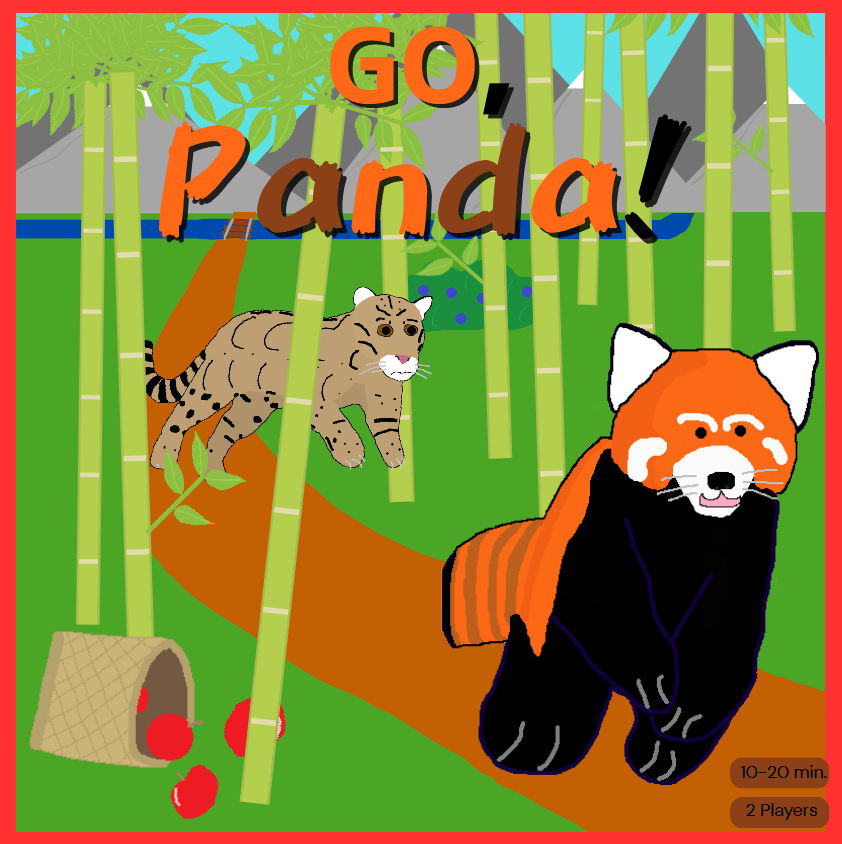
Go, Panda! is a board game created by me. It is a 2 player game where one player is a group of red pandas trying to collect fruit, and the other player is a clouded leopard trying to capture the pandas.
For this assignment the class was prompted to redesign the board game “Viva Topo.” It could be changed in terms of theme or mechanics, but had to be clearly derived from “Viva Topo.”
This was an individual project that included creating the mechanics, game board, and a rulebook, as well as running playtests for the multiple iterations of the game. The game itself was to be made playable on Google Slides. I also used MS Paint to create all the game art and assets, and Canva to put together the rulebook (most of the art for the rulebook was also made in MS Paint).
Game Design
When considering the prompt of redesigning “Viva Topo,” I saw it as an opportunity to change all the mechanics that I found unfun, which included the way the cat works, how dependent on luck the game is, and how slowly the game plays out. My design changes were meant to fix these issues.
First, I made the “cat” (in my case the leopard) be a player controlled unit. The cat in Viva Topo caused many problems in the game, with the biggest one being how players effectively had a 1/3 chance of losing their turn to rolling a “cat” on the die. If you get unlucky you lose your turn and are forced to put yourself in greater danger. One third of your turns you don’t get to do anything meaningful for yourself. Making the leopard player controlled fixes that. Now, when playing as the panda (my version of the mouse) you can’t lose your turn to the leopard. The leopard takes its own turns, and has equal chance as the panda of getting unlucky. This on top of the other decisions the player gets to make causes the game to not feel as luck dependent. In fact, in playtesting when I asked the participants if they got unfairly punished by bad luck during the game, no playtester felt this way.
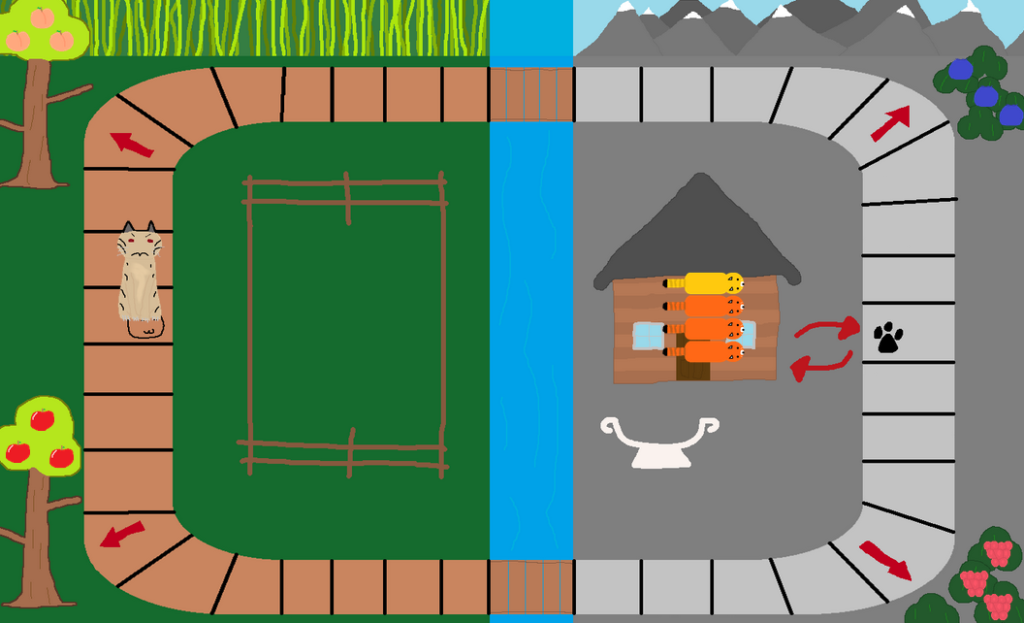
To combat the slow pace of “Viva Topo” was simple. In that game, the mice and cat don’t move very fast, with one mouse moving about 2.5 spaces per turn and the cat moving only about .3 spaces a turn for most of the game. This is what I believe led the game to feeling very slow paced. In Go, Panda!, the leopard moves an average of 4.5 spaces per turn and two pandas both get to move an average of 3.5 spaces per turn. The pieces in Go, Panda! move faster, which makes the game go faster (though not too fast!).
The game’s pacing is also helped by the fact it is only two players. The direct head-to-head competition and lessening of luck dependence make every turn in Go, Panda! feel meaningful and keeps the game actively engaging.
There was still plenty that went into balance the game, though. Since the leopard moves faster than the pandas and the pandas have tasks they need to complete with collecting the fruit, the leopard poses an imminent danger to the pandas. However, in all of my own playtesting the two sides ended up almost perfectly equal (about 55% winrate for the pandas). At first the game was heavily leopard favored, but through changing the number of spaces on the board and adding the golden panda mechanics I was able to balance it properly, and even after this balancing there is still plenty of strategy necessary to win at that 55% rate with the pandas. This higher skill ceiling is something that would hopefully keep players coming back for more, trying to get better.
Playtesting
This project consisted of two iterations with both requiring playtesting. I planned the playtests ahead of time with people I knew. I believe having the playtests planned out ahead of time put the playtesters in the right mindset to properly experience the game and give good feedback.
From the iteration 1 playtests, I learned that I needed to completely revamp the rulebook. The game itself worked exactly as intended and the playtesters enjoyed it. There weren’t any edge cases or bugs discovered, and any questions they had about the rules were already clarified in the rulebook. However, the rulebook was not well-made.
Originally, all the rules were written in a 4 page Google Docs file. All playtesters found it difficult to read and had trouble referring back to it to find answers to questions about the rules. Simply trying to format the file in a readable way did not help that it is boring and difficult to read a black and white text file. This is the thing I would change for the second iteration of the project.
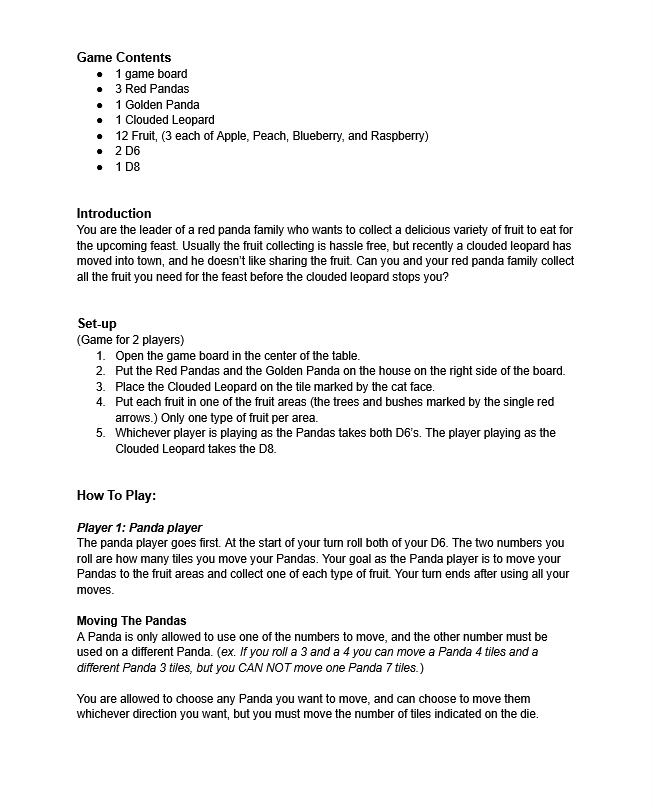
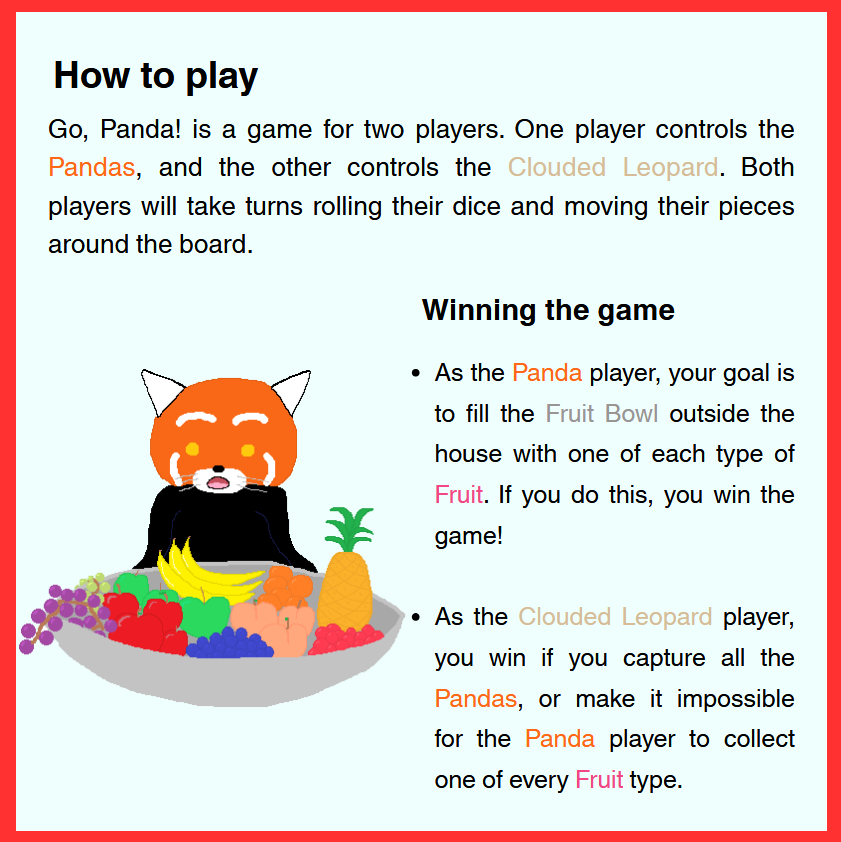
Using Canva and MS Paint, I designed a completely revamped rulebook. In this version of the rules, I reformatted everything and assigned colors to important words to make rules related to them easier to find. The headings and format makes it much easier to find what you’re looking for, the text style makes it easier to read, and the pictures and colors make it less boring.
During the second round of playtests, there was a very positive reaction to the rulebook. Playtesters liked the design and readability. During these playtests, when players had to refer to the rulebook for clarification on something, they found what they were looking for very quickly every time.
The gameplay itself was not changed based on any of these playtests. The reactions to the gameplay itself were unanimously positive. There was a playtester who questioned whether the leopard was too strong of a piece, but in that case the issue was more with them playing the pandas inadequately. After all of my own playtesting, I am fully confident in the mechanics and balance of the game and would not risk throwing it all off by changing something.
Given another iteration, I would not change anything. The last step of this project in my mind would be to make a physical version.